
Performance-Based Predictions: Why Outcomes Matter in Modeling
Predictive modeling uses historical data to estimate what will happen next. In lead buying, that estimate becomes a score that reflects how likely a lead is to convert, persist or have a higher lifetime value. Lead buyers across industries use these scores to optimize their spend and focus on the best opportunities. Insurance lead buyers use the same tools, but generic models have a tendency to miss the mark.
Algorithms and enrichment logic built to work across multiple industries rarely capture what drives a bound policy. A lead that scores well in one vertical can be a poor buy in another. Someone shopping for a policy is seeking coverage for a property or vehicles, not a home purchase where readiness to buy is the main signal. A carrier, brokerage, or agency buying P&C leads is weighing propensity to bind, expected premium, likely retention, and fit with its risk appetite, and those factors vary from one company to the next. The question is not only whether a lead will convert, but whether it will result in a policy the business wants to write.
A carrier, brokerage, or agency buying P&C leads is weighing propensity to bind, expected premium, likely retention, and fit with its risk appetite
Fake Leads Generate Fake Signals
Artificially intelligent lead scoring models have been around for a while, with varying degrees of success among lead buyers, especially in insurance. While models can claim to evaluate a lead’s propensity to bind or provide an estimated value of the lead’s worth in the marketplace, the lead industry is facing issues validating lead legitimacy.
Generative tools have made it cheap to produce leads that look legitimate in every field: a plausible name, a valid address, a clean and complete form. Some are synthetic identities stitched together from fragments of real data. Others come with fabricated documents attached. A model trained to reward complete, consistent submissions can end up rewarding the most convincing fakes. Lead buyers are right to question where scores come from, and how synthetic leads impact the quality of scores when a model attempts to make sense of large sets of data.
Preventing Drift Through Autonomous Retraining
Fenris introduced its Outcomes Service earlier this year, enabling autonomous retraining of all models available to Predictive Insights customers. Most scoring models are trained once and slowly lose accuracy until someone rebuilds them. Through the Outcomes Service, models keep learning from every result clients report, creating a continuous loop to sharpen model performance and deliver more accurate predictions. Once a predictive score is used in a live workflow, clients report back what actually happened using two values: the Submission ID from the original scoring request and a short outcome label such as bind, decline, lapse, churn, or a fraud flag. Fenris uses those results to retrain each client’s model against that client’s own performance. No client’s data is used to train or is exposed to another company’s model.
Clients have shared nearly 200 million outcomes to retrain their models, and Fenris now delivers about 15 million real-time scores each month. That volume translates into measurable results: clients have reduced customer acquisition costs by as much as 28% and delivered 39% more bound policies from the same agent hours.
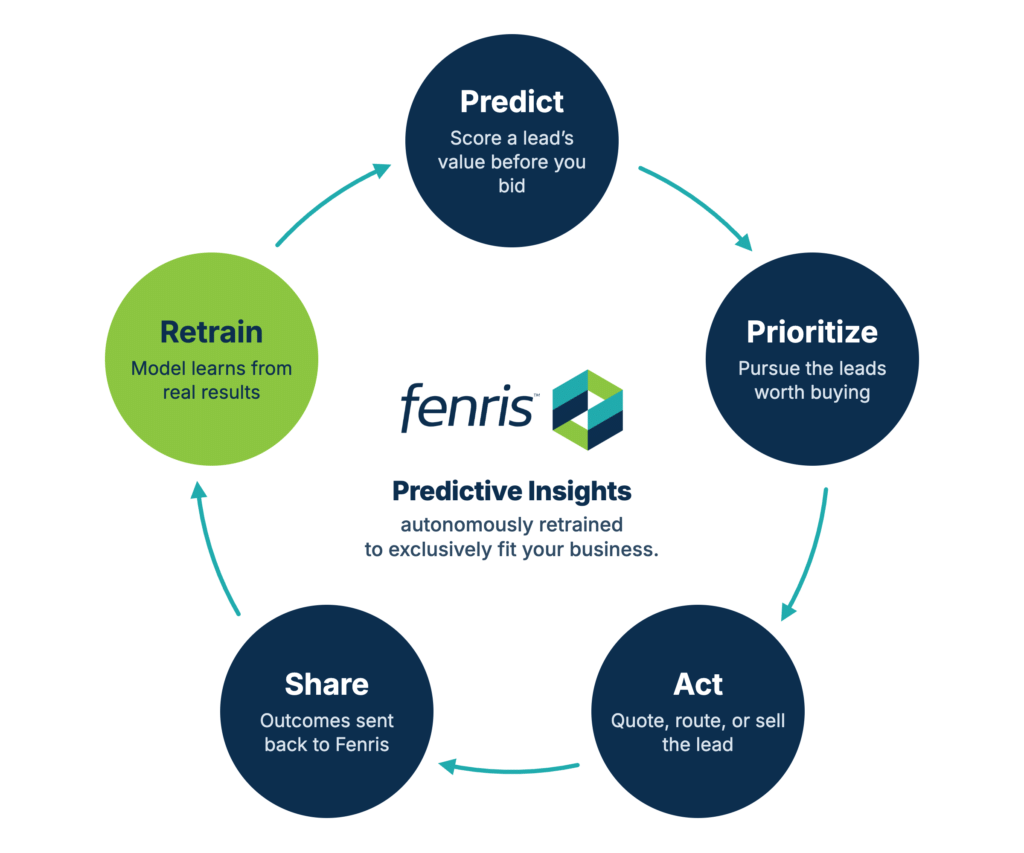
Because the model learns from real results rather than assumptions, its scores get more accurate over time across intake, quoting, underwriting triage, lead routing, and retention. When fraud flags are reported back, the model learns from what actually turned out to be fraudulent, which sharpens its ability to separate genuine data from false signals. That same feedback loop also guards against model drift, the gradual loss of accuracy that happens when real-world conditions change and the patterns a model was trained on no longer reflect what’s happening in the market.
A lead score is only useful if it reflects how a specific business wins. Two carriers can buy the same lead and see different outcomes based on their appetite, pricing, agent capacity, and book of business. A model built on generic logic treats them the same, but a model trained on real conversions can deliver accurate insights.